
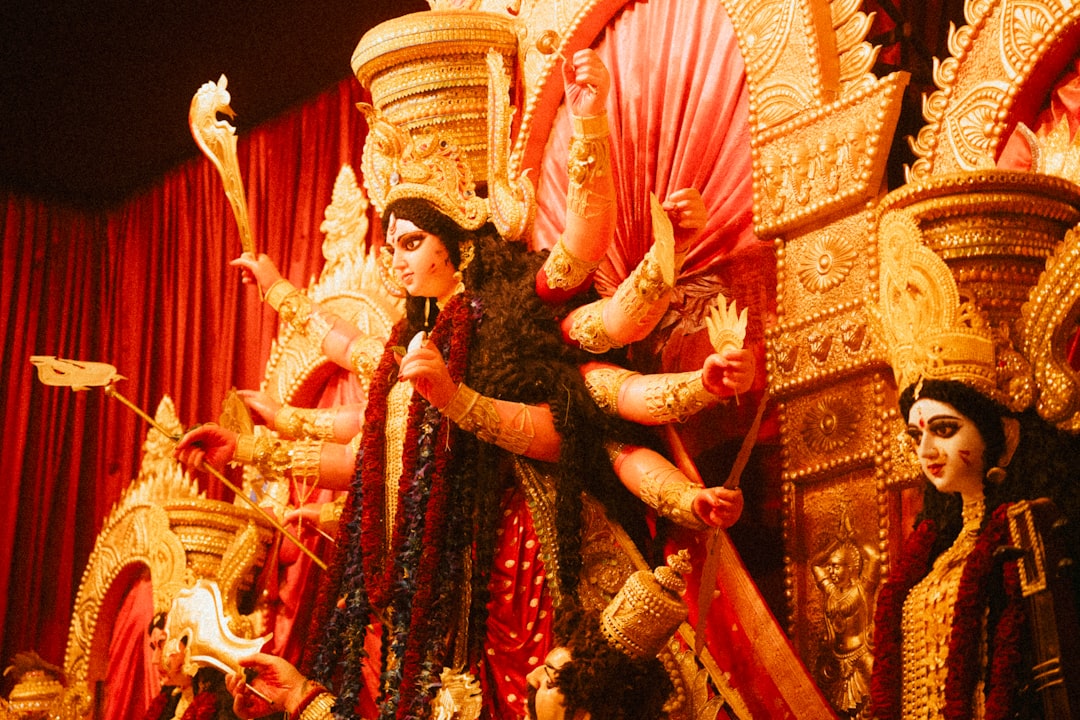
Close your eyes during Durga Puja and even before you see the pandal, you will know it has begun. A deep, rolling beat rises from somewhere in the distance, a conch shell answers it, and the air fills with the smell of dhuno smoke. For Bengalis, Durga Puja is not just seen – it is heard. Three sounds, more than any other, carry the soul of the festival: the taal of the Dhak, the fire-lit rhythm of Dhunuchi Naach, and the sacred call of the Shankh. At RNEPST, these are the sounds that turn our pandal at Rajnagar Extension into home for five days every year.
The Dhak: A Heartbeat Older Than Memory
The Dhak is a large, cylindrical drum slung over the shoulder of the Dhaki, and no Durga Puja is complete without its taal. Unlike a fixed tune, the Dhak speaks in rhythmic cycles – each one meant for a specific moment of the puja. There is a gentle, almost meditative beat for the quiet hours of Sandhi Puja, and there is the thunderous, feet-stomping taal reserved for Aarti and Visarjan, when the Dhaki throws his head back and plays as if in a trance.
Traditionally, Dhakis travel from villages in West Bengal to wherever Bengalis gather, carrying not just an instrument but a craft passed down through generations. When the taal builds and the crowd starts clapping along, something old and instinctive takes over – you don’t just hear the Dhak, you feel it in your chest.
Dhunuchi Naach: Dancing with Fire and Smoke
If the Dhak sets the rhythm, Dhunuchi Naach is where devotion becomes movement. Dancers hold a dhunuchi – an earthen or metal incense burner filled with burning coconut husk, camphor and dhuno – and sway, dip and spin to the Dhak’s beat, sometimes balancing the smoking pots on their palms, shoulders, or even their heads.
It began as an offering to Maa Durga during the evening Aarti, a way of surrendering oneself fully to the goddess through both breath and body. Today, it has also become one of the most joyous, participatory parts of the puja – uncles, aunties, teenagers and children all take turns stepping into the circle of smoke and drumbeats. There is no choreography to learn and no perfection required; the fragrant haze and the taal simply pull you in.
The Shankh: The Sacred Call That Opens the Ritual
Before the Dhak begins and long before the crowds gather for the evening’s festivities, it is the Shankh – the conch shell – that announces the beginning of a ritual. Blown by the women of the household or the priest, its long, resonant note is considered deeply auspicious, believed to ward off negative energy and invite divine presence into the space.
The Shankh Dhwani accompanies almost every significant moment of the puja – the Pushpanjali, the Aarti, and most movingly, the farewell during Bijoya Dashami, when the ulu-dhwani of the women blends with the conch’s call as Maa Durga is bid a tearful goodbye. It is a sound that has echoed through Bengali homes and pandals for centuries, unchanged and unmistakable.
Why These Sounds Matter to Us
At Puja Evam Sanskritik Trust, we believe Durga Puja is as much about preserving culture as it is about celebrating it. Every year at Rajnagar Extension, we make it a point to bring genuine Dhakis, encourage open participation in Dhunuchi Naach, and honour every ritual with the Shankh Dhwani – not as performance, but as living tradition. For many in our community, far from Kolkata and the villages of Bengal, these sounds are a thread back to home, to childhood, and to the generations before us.
So this Durga Puja, when you step into our pandal, pause for a moment before you look at the pratima. Listen first. Let the Dhak, the crackle of the dhunuchi, and the call of the Shankh remind you why this festival has stayed alive in our hearts for so long.
Jai Maa Durga!